

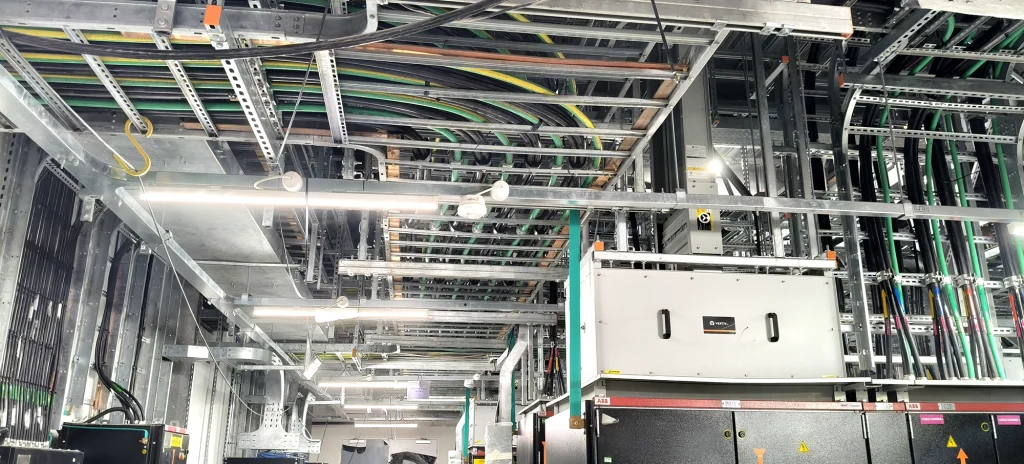
Modern infrastructure environments such as data centers, airports, healthcare facilities, metro rail systems, and commercial campuses depend on uninterrupted power and structured cable routing for operational continuity. In these environments, cable management is no longer treated as a secondary installation component. It has become a critical infrastructure system that directly impacts reliability, scalability, safety, and maintenance efficiency.
Selecting the right cable tray system plays a major role in ensuring long-term infrastructure performance.
Cable trays support and organize power, control, communication, and data cables across a facility. A poorly designed cable routing system can create:
Why Cable Tray Selection Matters
– Overheating issues
– Maintenance difficulties
– Unsafe cable congestion
– Installation delays
– Higher lifecycle costs
– Future expansion limitations
In mission-critical facilities, these risks can directly affect uptime and operational continuity.
An engineered cable management system helps ensure:
– Structured cable routing
– Proper airflow and heat dissipation
– Faster installation
– Easier maintenance access
– Better load management
– Improved system scalability
Understanding Different Types of Cable Tray Systems
Different project environments require different cable tray configurations.
Perforated Cable Trays
Perforated trays are commonly used where moderate ventilation and organized cable support are required. They are suitable for commercial buildings, healthcare facilities, and controlled electrical environments.
Key advantages:
– Better cable support
– Improved aesthetics
– Easier cable segregation
– Suitable for lightweight and medium-duty applications
Ladder Type Cable Trays
Ladder trays are preferred for high-load and large cable volume applications such as:
– Data centers
– Industrial plants
– Power distribution systems
– Utility infrastructure
Key advantages:
– Superior ventilation
– Higher load-bearing capability
– Faster heat dissipation
– Easier cable laying and maintenance
Raceway and Wireway Systems
Raceways and wireways are often used in environments requiring enclosed cable routing and cleaner architectural integration.
These systems are ideal for:
– Commercial interiors
– Airports
– IT spaces
– High-visibility installations
Choosing the Right Finish
Environmental conditions play a major role in determining tray life and performance.
Pre-Galvanized (PG)
Suitable for indoor applications with controlled environments.
Hot Dip Galvanized (HDG)
Recommended for:
– Outdoor installations
– Corrosive environments
– Industrial applications
– High-humidity locations
Powder Coated Systems
Preferred where:
– Architectural appearance matters
– Additional surface protection is required
– Color coding improves maintenance efficiency
Importance of Load Capacity and Structural Integrity
One of the most overlooked factors in cable tray selection is load capacity.
Improperly designed systems can lead to:
– Sagging
– Structural failure
– Cable stress
– Safety hazards
Important considerations include:
– Cable weight
– Future expansion loads
– Support spacing
– Span length
– Seismic considerations
– Vertical load conditions
Infrastructure-grade systems should always be validated for structural performance and manufacturability before production begins.
Why Modular Support Systems Matter
Modern infrastructure projects increasingly rely on modular C-Strut support systems because they offer:
– Faster installation
– Flexible routing
– Easier future modifications
– Reduced site fabrication
– Better coordination with HVAC and MEP systems
Modular systems help reduce installation complexity while improving execution speed on site.
Common Mistakes in Cable Tray Planning
Many infrastructure delays originate from incomplete cable management planning.
Common issues include:
– Underestimating cable volumes
– Ignoring future expansion
– Improper finish selection
– Poor coordination with other MEP services
– Excessive site fabrication
– Lack of engineering validation
These issues often result in:
– Rework
– Project delays
– Increased labor costs
– Reduced reliability
Why Engineering Validation Is Critical
The best cable management systems are engineered before manufacturing begins.
Engineering validation helps ensure:
– Proper load calculations
– Routing optimization
– Installation feasibility
– Coordination with site conditions
– Compliance with project standards
This significantly reduces execution uncertainty during installation.
ESMI’s Approach to Infrastructure Cable Management
At ESMI, cable management systems are designed with a strong focus on execution reliability, manufacturability, and long-term infrastructure performance.
Our integrated manufacturing capabilities include:
– CNC laser cutting
– CNC bending
– Roll forming
– Welding
– Precision fabrication
– Custom accessory manufacturing
We support infrastructure projects through:
– Factory-made custom bends and accessories
– Modular support systems
– Engineering-driven customization
– Fast turnaround execution
– Certified manufacturing processes
ESMI systems are trusted across:
– Data centers
– Airports
– Commercial infrastructure
– Healthcare projects
– Metro rail
– Industrial facilities
Conclusion
Cable management systems are no longer just support accessories. They are critical infrastructure components that influence safety, scalability, execution speed, and operational reliability.
Choosing the right cable tray system requires careful evaluation of:
– project environment
– cable load
– ventilation requirements
– installation conditions
– future scalability
– manufacturing quality
A well-engineered system helps reduce project risk while improving long-term infrastructure performance.
Contact ESMI for further information: mails [a]esmi.co.in
